Church altar flowers
Practical Tips for Beautiful, Meaningful Arrangements
Church altar flowers have a quiet responsibility.
They are not meant to dominate the sanctuary or compete with the purpose of worship. At their best, they bring warmth to the room, reflect the season, and help the altar area feel cared for without becoming distracting.
That balance can be harder to achieve than it looks.
A flower arrangement that seems perfectly sized on a kitchen table may look too small once it is placed in a large sanctuary. A beautiful bouquet may block the cross, interfere with microphones, or disappear behind the altar. Strongly scented flowers may become uncomfortable in an enclosed room, and delicate blooms may begin wilting before the service even starts.
Church flowers also need to work within practical limits. There may be a small budget, limited setup time, no refrigerator, and only one or two volunteers available to arrange everything.
The good news is that church altar flowers do not need to be elaborate to feel beautiful.
A thoughtful arrangement built with sturdy flowers, balanced proportions, and a clear understanding of the space will often look more appropriate than an expensive design filled with complicated details.
These practical church altar flower tips can help volunteers, wedding couples, ministry teams, and church staff create arrangements that are respectful, manageable, and suited to the sanctuary.
Begin With the Sanctuary, Not the Flowers
It is tempting to start by choosing flowers you love.
A better first step is to look carefully at the sanctuary.
Notice the height of the altar, the width of the platform, the position of the cross, and the location of the pulpit, lectern, candles, instruments, and microphones.
Ask where people will be standing and walking.
An arrangement placed directly in front of a microphone stand may look lovely before the service and become inconvenient once the worship team arrives. Flowers that extend too far into a walkway may be bumped during communion or special ceremonies.
Take a photograph of the altar from the main seating area.
This gives you a better sense of scale than standing close to the front.
Measurements are helpful too. Record the approximate height and width of the altar, pedestal, or flower stand. If the church already owns vases or urns, measure those as well.
A church altar flower arrangement should belong to the space rather than simply occupy it.
Ask About Church Traditions and Restrictions
Every church has its own approach to altar flowers.
Some churches follow a formal liturgical calendar. Others use flowers more freely. Certain seasons may call for specific colors, while other times of the year may be intentionally simple.
Before choosing the arrangement, ask:
Are there preferred colors?
Are any flowers discouraged?
Are artificial flowers allowed?
Can flowers be placed directly on the altar?
Are there height restrictions?
Does the church provide containers?
Who is responsible for removing the flowers?
Are there upcoming baptisms, communion services, memorials, or seasonal decorations?
It is especially important to ask before major religious seasons and holidays.
The sanctuary may already be decorated for Advent, Christmas, Lent, Easter, Pentecost, or another church observance. Adding unrelated colors or large floral displays may disrupt the planned design.
When in doubt, let the church’s worship or altar team guide the final decision.
Choose a Size That Can Be Seen
One of the most common church flower mistakes is creating an arrangement that is too small.
A centerpiece designed for a dining table may disappear when viewed from twenty rows away.
Church arrangements usually need more height, width, or visual weight than home arrangements.
This does not necessarily mean using more expensive flowers.
You can create scale with:
Greenery
Branches
Tall line flowers
Larger leaves
Repeated flower varieties
A wider container
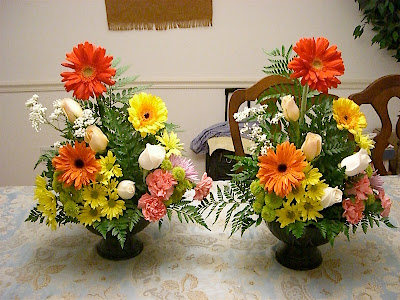
Two balanced arrangements
Step back frequently while arranging.
Do not judge the flowers only from arm’s length. Place the container on a table or pedestal and view it from across the room.
If the arrangement looks slightly oversized in the preparation area, it may be exactly right once placed in the sanctuary.
At the same time, avoid making it so tall that it blocks the cross, clergy, choir, or musicians.
Visibility should work in both directions. The congregation should see the flowers, and the people leading worship should still be visible.
Use Greenery to Create Shape and Volume
Greenery is one of the most useful tools in church altar flower arranging.
It creates height, width, and movement without requiring every space to be filled with expensive blooms.
Useful greenery may include:
Eucalyptus
Salal
Ruscus
Leatherleaf fern
Pittosporum
Myrtle
Olive branches
Magnolia leaves
Seasonal foliage
Garden greenery approved for indoor use
Begin with greenery before adding the main flowers.
Use it to establish the overall shape of the arrangement. Decide whether the design will be rounded, triangular, vertical, asymmetrical, or gently cascading.
For traditional altar flowers, a balanced triangular or oval shape often works well.
For a modern sanctuary, a looser asymmetrical arrangement may feel more natural.
Avoid placing every stem at the same height. Variation creates depth and prevents the design from looking stiff.
Be careful with greenery that sheds heavily or wilts quickly. Leaves scattered around the altar can create extra cleanup and may stain fabric.
Choose Flowers That Can Last Through the Service
Church altar flowers may need to remain fresh for several hours or even several days.
Choose blooms known for holding up well.
Reliable options often include:
Carnations
Roses
Chrysanthemums
Alstroemeria
Lisianthus
Orchids
Snapdragons
Stock
Delphinium
Hydrangeas with proper hydration
Lilies with careful handling
Seasonal branches
Quality greenery
Carnations and chrysanthemums sometimes receive less attention than trendier wedding flowers, but they are practical, affordable, and available in many colors. When grouped thoughtfully, they can look full and elegant.
Roses are versatile and familiar, while snapdragons, stock, and delphinium add height.
Hydrangeas create volume quickly but need plenty of water. They may wilt if left in a warm room or transported without support.
Delicate flowers such as sweet peas, garden roses, poppies, and some wildflowers can be beautiful, but they may require more careful handling and may not be the best choice when the arrangement must last through a long weekend.
Be Careful With Strong Fragrance
Fragrant flowers can make a sanctuary feel inviting, but too much scent may become uncomfortable.
Church members may have allergies, asthma, migraines, or fragrance sensitivities. Choir members, clergy, and musicians may stand near the flowers for an extended period.
Strongly scented flowers can include:
Lilies
Hyacinths
Gardenias
Tuberose
Stock
Some varieties of eucalyptus
This does not mean these flowers can never be used.
Use them sparingly and ask whether the church has fragrance restrictions.
Remove lily pollen carefully before placing the flowers. Pollen can stain altar cloths, clothing, carpet, and hands.
If the sanctuary is small or poorly ventilated, choose flowers with little or no noticeable fragrance.
Build a Simple Color Palette
Too many colors can make church flowers feel busy.
A limited palette usually looks more peaceful and intentional.
Choose one main color, one supporting color, and greenery.
Examples include:
White, ivory, and green
Blush, cream, and green
Burgundy, soft pink, and green
Blue, white, and silver-green foliage
Yellow, white, and green
Purple, lavender, and green
White and green arrangements are especially versatile. They work for weddings, memorials, Sunday worship, and many church seasons.
Seasonal color can also be effective.
Spring may invite soft pinks, yellows, lavender, and fresh green. Summer can support brighter garden colors. Autumn works well with rust, burgundy, gold, and textured foliage. Winter arrangements may include white flowers, evergreen branches, berries, or restrained touches of red.
The color palette should support the church environment rather than compete with stained glass, banners, altar cloths, or seasonal decorations already present.
Use Containers That Feel Stable and Appropriate
The container is part of the design.
Church altar arrangements are often placed on elevated surfaces, so stability is essential.
Avoid lightweight vases that can tip easily.
Good options include:
Heavy ceramic urns
Metal pedestal containers
Weighted glass vases
Church-owned brass containers
Waterproof liners inside decorative urns
Low, wide containers for stable arrangements
Check whether the container leaks before bringing it into the sanctuary.
Place water-filled arrangements on a protective tray if the surface could be damaged.
If using floral foam, make sure it is fully saturated and secured inside the container. Add water slowly after setup because foam can dry out, especially in a warm sanctuary.
Reusable mechanics such as floral frogs, chicken wire, or pin holders may provide more natural stem placement and reduce waste, but they must be secured carefully.
Create a Clear Front and Back
Many church arrangements are viewed mostly from the front.
This allows you to focus the best flowers toward the congregation while using greenery and supporting stems at the back.
However, some altar areas can be seen from several directions.
Walk around the space and determine which angles matter.
For a front-facing arrangement:
Keep the back relatively flat
Direct most blooms forward
Use the tallest stems near the back center
Allow side flowers to extend gently outward
For an arrangement viewed from all sides:
Distribute flowers evenly
Avoid exposed foam or mechanics
Rotate the container while arranging
Check the design from every direction
Knowing the viewing angle can save flowers and prevent wasted effort.
Consider Two Arrangements Instead of One
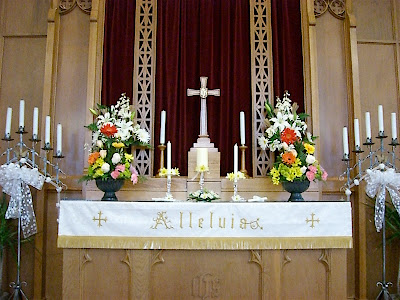
Two coordinated arrangements can create balance around a central cross, altar, pulpit, or communion table.
They do not need to be perfectly identical.
Matching colors, containers, and overall size are usually enough.
Use one arrangement on each side and leave the center visually open.
This can be more effective than one oversized arrangement placed directly in the middle.
Two arrangements are also easier to repurpose after the service. They can be moved to a fellowship hall, church entrance, memorial table, or care facility.
Make sure the placement does not create a false sense of symmetry when the sanctuary itself is asymmetrical. Sometimes one larger arrangement and one smaller supporting piece may fit the space better.
Prepare as Much as Possible in Advance
Church flower setup often happens early in the morning or shortly before a service.
Reduce stress by preparing ahead.
The day before, you can:
Clean containers
Condition greenery
Trim stems
Remove damaged leaves
Sort flowers by type
Prepare mechanics
Label arrangements
Pack towels and tools
Confirm delivery access
Review the church schedule
Bring a simple flower kit containing:
Floral clippers
Scissors
Floral tape
Clear tape
Wire
Paper towels
Trash bags
Extra greenery
A few replacement flowers
Watering can
Small funnel
Protective cloth
Gloves
Do not assume the church has flower tools available.
Transport Arrangements Upright
Transportation can damage an arrangement faster than the service itself.
Use sturdy boxes, crates, or plastic bins to hold containers upright. Add towels around the base to prevent movement.
For tall arrangements, use an SUV or vehicle with enough vertical space.
Avoid placing arrangements directly on seats where they may tip during turns.
Carry extra water separately and top off the containers after placing them.
During very hot or cold weather, avoid leaving flowers in the vehicle. Temperature extremes can damage blooms quickly.
If transporting two arrangements, label their intended placement:
Left side
Right side
This can be useful when the designs have slightly different shapes.
Check the Arrangement From the Congregation’s View
Once the flowers are in place, walk to the middle and back of the sanctuary.
Look for:
Flowers blocking the cross
Uneven height
A visible container liner
Drooping stems
Awkward empty spaces
Reflections from glass
Water near the base
Loose leaves
Interference with microphones or candles
Take a photograph from the center aisle.
A photo often reveals balance problems that are difficult to notice in person.
Make only a few final adjustments.
Overworking the arrangement can weaken stems and disturb the design.
Plan What Happens After the Service
Church flowers often remain beautiful after worship.
Decide in advance what will happen to them.
They may be:
Left in the sanctuary
Moved to the church entrance
Used during a second service
Divided into smaller bouquets
Given to homebound members
Taken to a care facility
Shared with a grieving family
Used at a fellowship meal
Compostable once they fade
If the containers must be returned, label them clearly.
Avoid leaving the church staff to guess whether the vases belong to the florist, donor, or church.
A small written note can prevent confusion.
Keep the Meaning Simple
Church altar flowers do not need to be extravagant.
Their purpose is not to impress the congregation with expense or complexity.
They may mark a wedding, honor a loved one, celebrate an anniversary, remember someone who has died, or simply bring seasonal beauty into the sanctuary.
A small card or bulletin note may be appropriate:
The altar flowers are given with gratitude in celebration of our parents’ anniversary.
Or:
Today’s flowers are offered in loving memory of Jane Smith.
Coordinate the wording with the church office.
Some churches have a standard format or altar flower calendar.
Avoid Common Church Flower Mistakes
A few practical mistakes appear often.
Arrangements That Are Too Small
The flowers disappear when viewed from the back of the church.
Arrangements That Are Too Tall
They block the cross, clergy, or choir.
Too Many Delicate Flowers
The design begins wilting before the service ends.
Containers That Leak
Water damages wood, fabric, or carpet.
Strong Fragrance
The scent becomes uncomfortable in a small sanctuary.
Unconfirmed Setup
Flowers arrive when the building is locked or the altar is already decorated.
No Removal Plan
The church is left to dispose of flowers and return containers without instructions.
Most of these problems can be prevented with one conversation and a little preparation.
Let the Flowers Serve the Space
The most beautiful church altar arrangements are not always the largest or most expensive.
They are the ones that feel as though they belong.
They respect the architecture, the worship tradition, the people leading the service, and the congregation gathered in the room.
They can be seen without becoming a barrier.
They add color without creating visual noise.
They remain fresh because the flowers were chosen and handled carefully.
They are easy to receive, display, and remove because someone planned the practical details.
Church altar flowers are temporary by nature.
They bloom, they are arranged, and eventually they fade.
That temporary beauty is part of their meaning.
For one Sunday, one wedding, one memorial, or one celebration, they help mark a moment.
With the right flowers, a stable design, and thoughtful preparation, even a simple arrangement can bring grace and warmth to the sanctuary.
Comments
We admire work of Harvard University Arts and Fashion - best school of arts where great designers learn
how to create great looking designer clothing!